In August 2026, Think with Google published a Cannes conversation on AI search visibility and thought leadership. The people on the chairs were Linda Ha, deputy CMO of Ikea; Dan Finley, group CEO of Debenhams Group; and Andy Wells, VP of growth marketing at DoorDash. Queries are getting longer. Search is more conversational. Ads are more automated. When Google asked what that means for organic traffic, the answer they printed was not a new acronym. The best formula, they wrote, is still foundational SEO.
This post is for one search: foundational seo. The product link is the free all-in-one scan at tools.positionmysite.com/tools/ALL. That scan will not tell you if Gemini named you, or if you have thought leadership. It will tell you whether the URL you paste is failing the on-page and site signals that still have to work before any of those Cannes stories apply.
What Ikea, Debenhams, and DoorDash actually said
Dan Finley framed Debenhams as 248 years old and still trying to show up for extended search terms with richer content and more relevant imagery. People are discovering the retailer through longer queries, not just the homepage they already know. He compared the ambition to what Spotify did for music: a destination of choice, not a single catalog page.
Andy Wells said DoorDash is seeing the same shift inside ordinary Search, not only AI Mode: about 27 percent longer queries year over year. A gig worker is not typing “find a job.” They are typing something like “best gig delivery jobs in San Jose.” DoorDash also said they have more than 500,000 product SKUs that are available at some local merchants and not others. Their organic point was blunt. They do not treat answer-engine optimization as a separate religion. They keep working on site architecture, structured data, and making sure crawlers can read the catalog so Gemini and Google AI Overviews have something accurate to recommend.
Linda Ha said Ikea starts from Ikea Family data — over 200 million members — and then uses Search to see what people do outside Ikea. Kitchen planning was the example: a long, messy journey where complementary products matter. The work they named first was an integrated search foundation, including local nuances, and only then the rest of paid, owned, and earned.
That is the useful part for everyone who is not Ikea, Debenhams, or DoorDash. Longer queries and AI answers still sit on top of pages that can be crawled, titled, structured, and kept consistent. Google even titled that section of the piece “Good SEO is good GEO.”
None of that works if the pages are broken
Thought leadership is a publishing problem. Foundational SEO is a site problem. A kitchen guide that never gets a title, a product URL that canonicalizes to a 404, or a template that noindexes every city page will not become more visible because someone at Cannes talked about conversational search.
The mistake we see is treating “AI visibility” as a new dashboard while the same site still has missing titles on half the templates, a robots rule leftover from staging, or broken internal links three clicks off the homepage. Rank tracking will show the drop. It will not show the missing H1 on the category template you never opened.
PositionMySite SEO Site Signals is built for that second job. It is not a thought-leadership scorer. It is not an AI Overview detector. It checks on-page metrics and site signals on the URL you give it, and — once you are in the workspace — it can crawl the site and surface broken links and other sitewide issues instead of pretending the homepage is the whole property.
What the free scan actually does
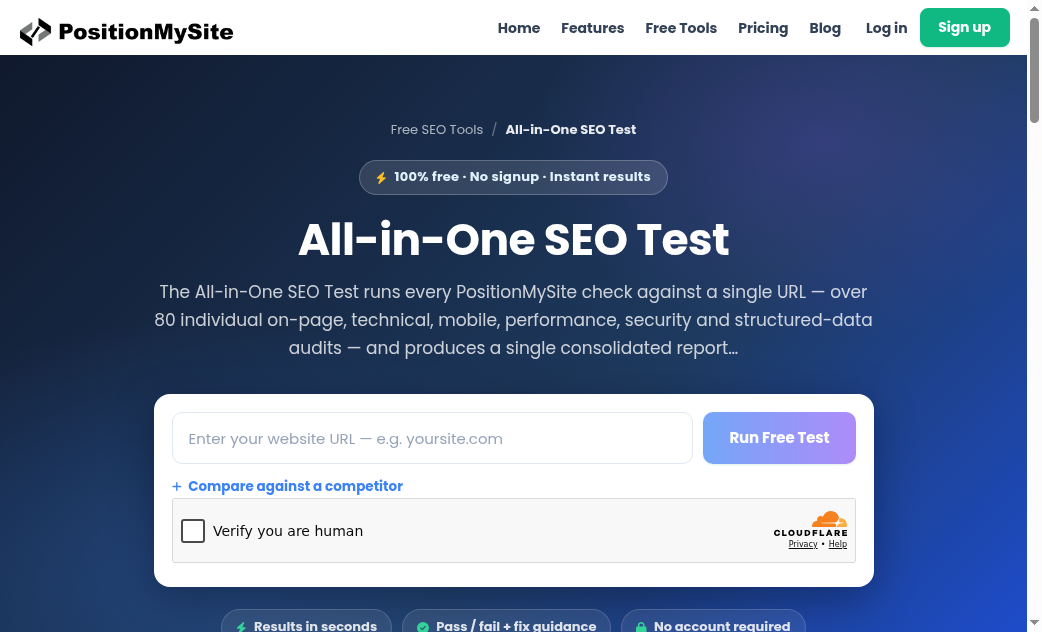
Open the All-in-One SEO Test. Paste a URL. Homepage, product, article, contact — any live URL. No account. In about a minute you get a pass/fail across 80+ checks on that one URL: title, description, headings, schema, robots.txt, sitemap, canonical, redirects, mobile, Core Web Vitals, code quality, security, and the rest of the on-page and technical set.
That is a URL test. It is not a site crawl. If you paste the homepage, you learn about the homepage. You do not learn that the blog pagination is noindexed, that the category template dropped its H1, or that twenty product URLs 404. The live page itself says the test runs every check against a single URL, and the FAQ says to audit one example of each template, not the whole site from one paste.
Use it that way. Run the homepage. Run a money landing page. Run one product or service template. Run one article. Fix the critical and high items first — blocked, redirected, empty title, broken canonical — before you rewrite copy for a conversational query that the page cannot even keep in the index.
Sitewide issues live in the workspace crawl
Sitewide crawl, broken-link monitoring, and notifying you when those issues show up across the site are logged-in workspace features. They are not what the public /tools/ALL form does. After you create an account and add the site, the workspace is where you run a full-site crawl and review broken links. The public test stays a paste-a-URL scan.
That split matters. A homepage score of 82 can sit on top of a catalog full of leftover 404s. AI search does not fix that. Neither does another keyword list. You need the page-level signals and then a crawl that walks past the homepage.
Keyword position tracking is also in the workspace. It is useful. It is not the core of this post. If the only thing you watch is rank, you will see a URL fall and still not know the template lost its title last Tuesday. Foundational SEO is the title, the indexability, the internal links, the structured data, and the broken pages you never opened.
A short pass after the Google piece
- Read the Think with Google conversation once. Note the line about foundational SEO. Do not turn it into a new content calendar before you know the pages work.
- Paste your homepage into the all-in-one test.
- Paste one URL from each important template. Same test. Different URL.
- Fix what is blocked, redirected, or empty before you touch ads or “AI-ready” copy.
- If you need the rest of the site, log in and run the workspace crawl and broken-links views. That is the sitewide pass. The free form will not do it.
If those checks are clean and you still never appear in an AI answer, that is a content and entity problem, not a missing new tool. This page is the foundation check.
What to do today
Paste a live URL into the free All-in-One SEO Test. Read the on-page and site-signal failures. Then, if you care about more than one URL, sign in and crawl the site. Ikea, Debenhams, and DoorDash can talk about conversational search because they already have a catalog crawlers can read. Start there.