Google’s August 2026 spam update is done. It started Tuesday, August 18 around 12:30 p.m. ET and finished Friday, August 21 around 4:50 a.m. ET. That is 2 days and 16 hours, and it is on the official Search Status Dashboard. There was no Search Central blog post. Google called it a normal spam update, global, all languages.
If your traffic wobbled last week, do not treat every dip as this update. Search Console also had a logging bug on the Generative AI performance report from August 13 to 17. That bug undercounted impressions. It was not a ranking change. John Mueller said so. The dates sit next to the spam update. They do not overlap.
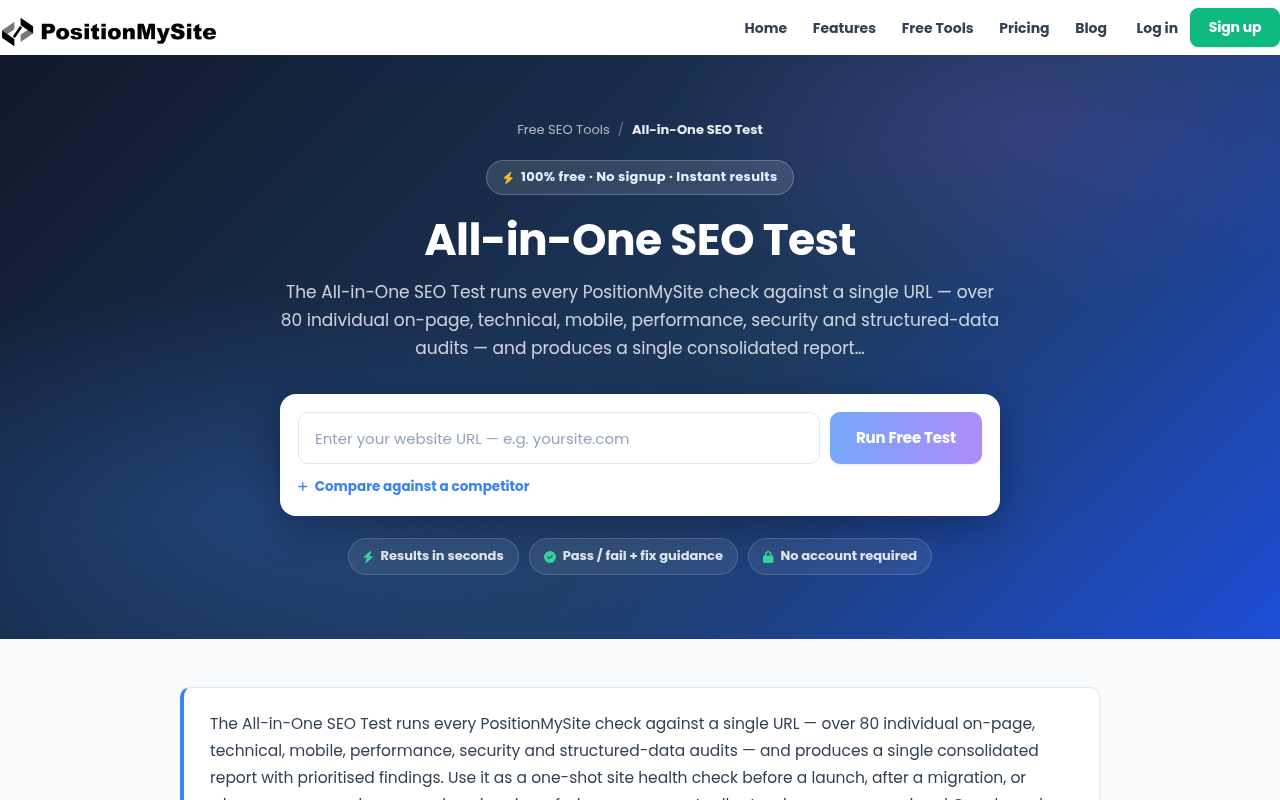
This post is for one search: google august 2026 spam update. The only product link is the free all-in-one scan at tools.positionmysite.com/tools/ALL. That scan will not tell you if Google labeled you as spam. It will tell you what is broken on the page you can still fix.
What this update was, and what it was not
This was the third named spam update of 2026. Barry Schwartz reported it does not target link spam or site reputation abuse. Google did not publish a new spam policy. Recovery, if you were actually hit, means reviewing the existing spam policies. Google says that can take months, not a weekend rewrite.
It was not a core algorithm update. The dashboard shows no August 2026 core update. The last named core update was May 2026. Pre-August 18 volatility is not this spam update. Do not write a “we recovered” post until you have clean data after August 21.
Read Search Console with the right dates
Use two windows. Baseline: a stretch that ends August 17 or earlier, and skip treating August 13 to 17 Generative AI impression counts as real. After-update: August 21 onward. Compare clicks, queries, and landing pages in those two windows. If the only thing that moved is the Generative AI impression line between the 13th and the 17th, that is the logging bug.
Discover had its own logging error on August 13. Same rule. Do not call that a Discover collapse.
Look at pages, not just the domain. A spam action often shows up as a handful of URLs falling out while the rest of the site holds. If everything dropped in lockstep, look at tracking, seasonality, or a botched deploy before you assume a site-wide spam action.
What to check on the site itself
Google’s spam policies still cover cloaking, sneaky redirects, scaled scraped content, expired-domain abuse, doorway pages, and thin pages built only to rank. None of those are a Core Web Vitals problem. A green Lighthouse score does not clear a spam action.
What you can check in an afternoon:
- Which URLs lost clicks after August 21, not during the 13 to 17 logging gap.
- Whether those URLs still return 200, still have a usable title, and are not noindexed by accident.
- Whether a redirect chain or a meta refresh is sending people somewhere they did not click.
- Whether the HTML Google can fetch actually matches what a user sees.
- Whether the sitemap still lists URLs you already killed or that now 404.
That last group is ordinary indexability work. It is also the work most teams skip while they wait for a “recovery” that never comes because the page is blocked, redirected, or empty.
Run the pages that moved
Open the all-in-one SEO test. Paste one of the URLs that lost clicks after August 21. You get an 80-signal pass on that URL: title, robots, canonical, noindex, redirects, schema, and the rest of the on-page and crawl checks. Do this for the losers, not for a random homepage vanity scan.
Read the indexability block first. If the page is noindexed, canonicalized to a different URL, or caught in a redirect loop, fix that before you rewrite the copy. A spam review that starts with a URL Google cannot keep in the index is wasted time.
Then look at the content signals the scan can actually see: missing title, empty description, thin text-to-HTML, broken heading structure. Those do not prove you were in the spam set. They do prove the page is easy to ignore once Google re-crawls it.
If the scan is clean and the URL still fell off after August 21, stop guessing with more audits. Go back to the policy list. Scaled doorway templates, affiliate blocks with no added value, and scraped pages are the usual leftovers. Those are takedown and rewrite problems, not another plugin.
Do not mix this week’s other Search news into the same diagnosis
Generative UI started showing up in AI Overviews on August 19. Preferred Sources got an embeddable button on August 20. Googlebot’s JSON-LD parser now does a single HTML unescape pass, around August 20. None of those are the spam update. None of them explain a Friday-to-Monday click drop on a set of thin URLs.
If you also saw a hole in the Generative AI report last week, annotate it as the 13 to 17 logging error and move on. Do not use that chart as proof you were hit on the 18th.
What to do today
Pick the ten URLs with the biggest click change from a clean pre-August 18 baseline to August 21 and after. Run each one through the free all-in-one test. Fix the ones that are blocked, redirected, or empty. Leave the ones that look like policy problems in a separate list and deal with those as content, not as a score.
If nothing material moved after August 21, you were probably watching the GSC bug or normal noise. Do not file a reconsideration request because a chart looked ugly on a Thursday.