A website positioning tool answers one question: where do you actually show up on Google for the searches that pay the bills?
Most people type that into Google and land on a generic SEO audit page. That is why they leave. Position is not the same thing as a technical score. You need both. Position tells you if you are visible. The scan tells you why you are stuck on page 2 or page 3.
This is the free version of that workflow. Check the idea, run the scan, then keep watching the keywords that matter.
What website positioning actually means
Positioning is your rank for a specific query, in a specific place, on a specific device. It is not a sitewide grade.
“Check SEO positions” is a set of facts:
- the query (the words someone typed)
- the URL that ranked
- the city or country Google used
- desktop versus mobile
- whether you showed up as a normal blue link, a map pack, or something else
If a tool only gives you a letter grade and no keyword positions, it is not a positioning tool. It is an audit. Useful. Different job. A plumber in Mississauga who ranks #3 on desktop in Toronto and does not appear on mobile in Mississauga does not have “an SEO score of 72.” They have a positioning problem in one market.
How to check your SEO position today
1. Pick 3 to 10 money queries
Skip brand terms. Use the phrases a new customer would type. For a local shop that is “plumber in [city]”. For a product like a PTO app that is “time off tracker” or “employee leave software.” For us, the job-to-be-done query is “website positioning tool.”
2. Search the way they search
Incognito is not enough. Google personalizes. Use a rank checker that can set city and device, or search from a clean browser with a location set. If your customers are in Toronto, a result from a VPN in Virginia is a different SERP.
3. Record the URL, not just the number
Position 7 on the wrong page is a different problem than position 7 on the right one. Write down which URL ranked. If the blog is ranking and the product page is not, you do not need more blog posts. You need the product page to deserve the query.
4. Then ask why
If you are on page 2, the next click should be a site scan, not another keyword tool. Titles, indexability, speed, and thin pages are what keep a decent URL from moving.
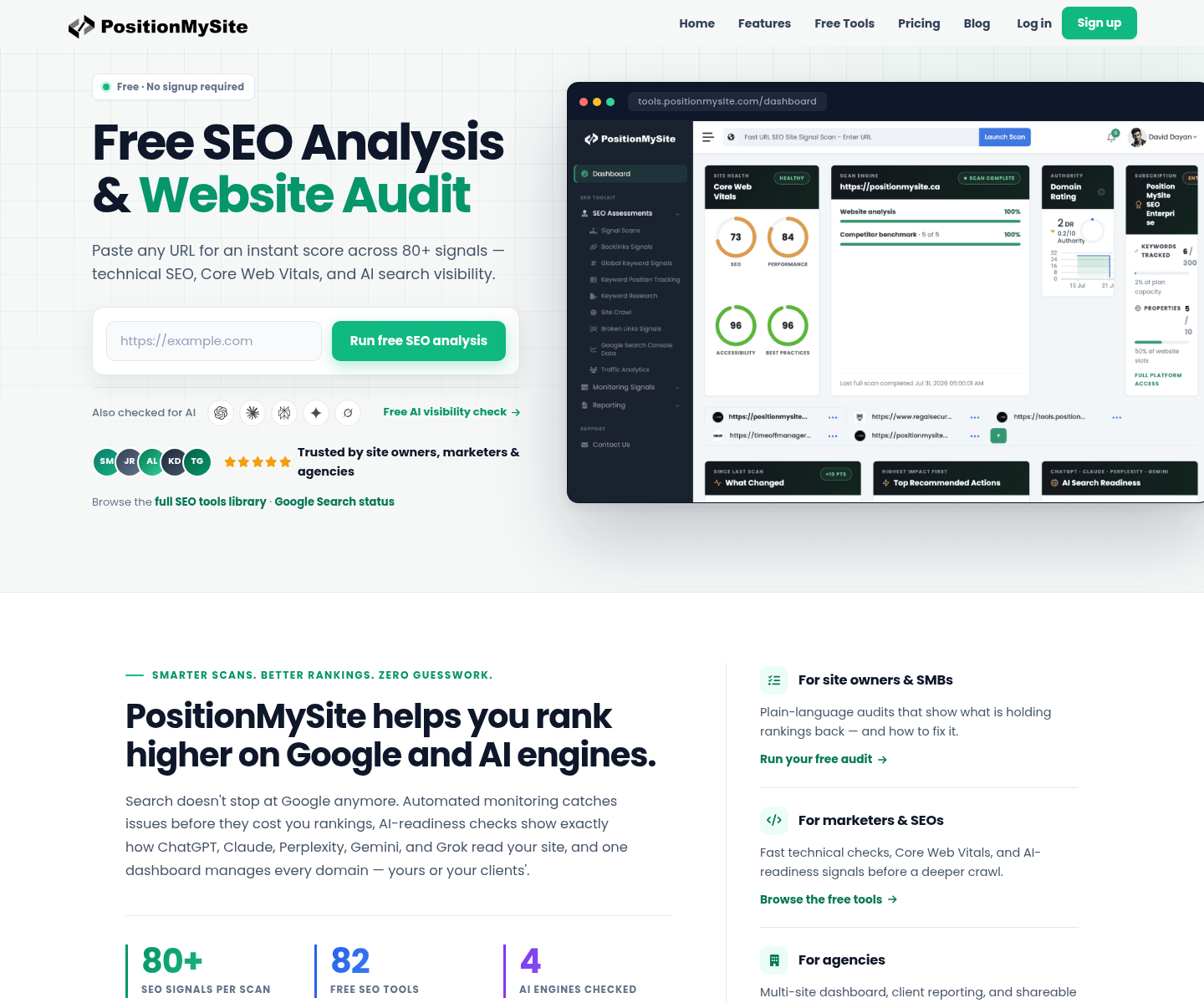
Run that scan with the All-in-One SEO Test. Paste the URL that should be ranking. You get a score, pass/fail on 80+ signals, and a list of what to fix first. No account required.
A weekly positioning routine that takes 20 minutes
- Pull positions for your core queries.
- Note anything that dropped more than a few spots.
- Re-run the all-in-one check on those URLs.
- Fix the top two issues, not the whole report.
- Re-check next week.
If you only do the scan and never look at positions, you will polish a page nobody is finding. If you only watch positions and never scan, you will stare at a drop with no idea what broke.
Keyword tracking, city-level ranks, and competitor views live in the PositionMySite workspace. The free tests stay free. Tracking is what you turn on when one check is not enough: daily history, more than a handful of keywords, and alerts when something moves.
If the drop is speed, do not guess
Sometimes the URL is right and the page is just slow. Google does not need a perfect Lighthouse score. It does need a page that paints content quickly and does not jump around.
Start with First Contentful Paint or render-blocking resources. Fix the top item. Re-test the same URL. Then look at positions again next week. Speed work that is not tied to a ranking URL is just homework.
When you want someone else to fix the on-page issues
The report is the same one we use. If you want us to implement the title, headings, internal links, or indexability fixes, send the URL. We work from the scan, not from a generic retainer deck.
What to do next
- Need a score and a fix list right now: run the free SEO check.
- Need ongoing positions, cities, and alerts: create a workspace and add the site.
- Want the on-page issues fixed: tell us the URL. Same report, we do the work.
Position first. Then the why. Then the fix.